
Will massage help your baby sleep better?

Massage and your baby’s sleep

It is the question I am asked most at the workshop, usually with a mix of hope and exhaustion. The honest answer is yes, but not in the way you are thinking.

There are two things worth keeping apart. What almost every family believes massage does, and what you see when a baby’s sleep is measured with an electroencephalogram. They do not match.

And there is a third, the one that really matters to me as a physiotherapist: the effect depends on how you do it.

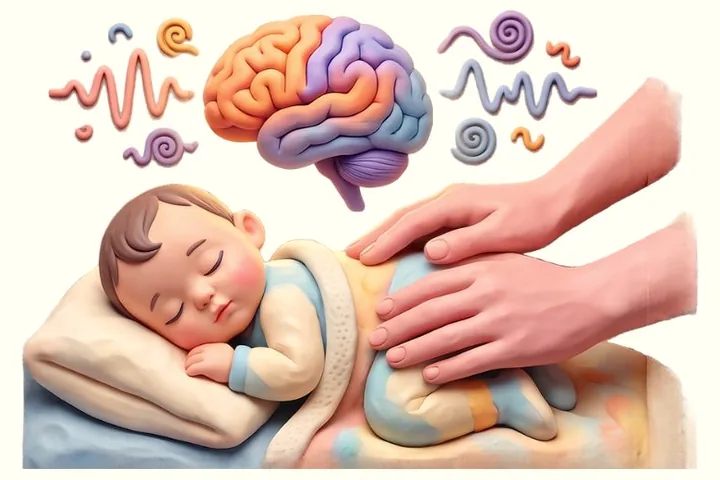
Illustration: a baby sleeps on their side while a pair of hands massages their back; above them, a brain and coloured waves.
Illustrative image.

What almost everyone believes

Infant massage is not a recent fashion. In a study of 1,497 caregivers in two states of India, 93.8% massaged their baby, and 82% had started in the first week of life.

The interesting part is what they expected from it. Among the benefits most often perceived were stronger bones, better growth and sleep.

The belief is so widespread that hardly anyone questions it. And it is exactly the one that was put to the test in Ireland.


What the electroencephalogram saw

In Cork, the INFANT research centre did something almost nobody had done: instead of asking mothers whether their baby slept better, they put electrodes on the babies.

They recruited 182 healthy babies born at term. Half were assigned routine massage given by their parents; the other half were not. At four months they recorded every baby’s sleep with an electroencephalogram, and they assessed their development at 4 and at 18 months.

Something did change, and it is not small

The massaged babies showed greater power in their sleep spindles. Spindles are brief bursts of electrical activity that appear while a baby sleeps and are used as a marker of brain maturation.

The magnitude of the signal and the communication between the two hemispheres changed too. The authors sum it up like this: routine massage is associated with distinct functional brain changes at four months.

And nothing changed that you notice at night

There were no differences in how long the sleep stages lasted. Nor in how long they took to fall asleep. Nor in how long the nap lasted. Nor in the structure of the first sleep cycle.

Nor were there differences in development, at four months or at eighteen.

So the popular belief is not false, but it is aimed at the wrong thing. Massage leaves a measurable mark on your baby’s brain while they sleep. What it does not do is make a healthy baby sleep longer.


So what does improve?

Here is the good news, and it is very specific.

A trial with 123 families compared a bedtime routine with massage against their usual routine, in babies aged 3 to 18 months. What improved were night wakings, for both the baby and the mother.

What did not improve was how long they took to fall asleep, total sleep time or the longest stretch of sleep. The authors say so plainly in their conclusions.

And there is something you can check for yourself this week: in another study by the same team, with 134 families, the fastest change came in the first three nights.


Why how you do it matters

This is the part that is almost never told, and the part that interests me most.

When all the research is looked at together, a very clear pattern appears: massage almost never wins on its own. It wins when it is done with the right pressure, together with contact and as part of a routine. That cannot be improvised.

Pressure has a dose

A meta-analysis of 15 trials and 697 premature babies compared moderate pressure with light pressure. Daily weight gain was 5.60 g with moderate pressure and 1.08 g with light pressure.

That study measured weight, not sleep. But it is the best demonstration there is that massage has a dose: stroking lightly over the surface does not have the same effect as a massage given well. And finding that point, in a baby who cannot tell you anything, is something you learn with your hands.

Timing and consistency

In the studies that worked, massage was not something done now and then. It was part of a fixed sequence before sleep, repeated every night. That is why the change shows so soon, and why it fades if the routine breaks.

A massage done badly is rarely dangerous. But it can overstimulate your baby just when you want the opposite, and then the conclusion you take home is that “massage doesn’t suit my child”. Almost always it is not the massage: it is the pressure, the timing or how their signals are read.


What you can really expect

If someone promises you that massage will make your baby sleep through the night, they are not telling you what the evidence says.

What you can expect is this: that they wake fewer times, that bedtime stops being a battle, and that you notice it within a few days. Add something no commercial promise mentions: you will sleep better too.

And there is the rest, what the electroencephalogram did pick up even though you cannot see it. Ten minutes of contact with your hands, every night, leave a trace in a brain that is still being built.

Nobody here is going to judge how you are doing it. If you want to learn to give it with judgement, with the right pressure and knowing how to read your baby’s signals, that is exactly what we do in the infant massage workshop.


Upcoming workshop dates

Book your place on WhatsApp with the button below.

Monday 26 October and 2 November

4:00 to 5:00 pm · Llevadonas (Sagrada Família, Barcelona)

Monday 14 and 21 December

4:00 to 5:00 pm · Llevadonas (Sagrada Família, Barcelona)

Sources

  • Ventura S, Mathieson SR, O’Sullivan MP, et al. Parent-led massage and sleep EEG for term-born infants: a randomized controlled parallel-group study. Developmental Medicine & Child Neurology, 2023. https://doi.org/10.1111/dmcn.15565
  • Rohmah I, Mukminin MA, Hasan F, et al. Comparative effects of nonpharmacological interventions on sleep-wake states among preterm infants in NICUs: a systematic review and network meta-analysis. Intensive & Critical Care Nursing, 2025. https://doi.org/10.1016/j.iccn.2025.104168
  • Belpınar A, Yayan EH, Özdemir A. The effect of massage and foot reflexology on sleep in newborns. Biological Research for Nursing, 2025. https://doi.org/10.1177/10998004251332911
  • Mindell JA, Lee CI, Leichman ES, Rotella KN. Massage-based bedtime routine: impact on sleep and mood in infants and mothers. Sleep Medicine, 2017. https://doi.org/10.1016/j.sleep.2017.09.010
  • Mindell JA, Leichman ES, Lee C, Williamson AA, Walters RM. Implementation of a nightly bedtime routine: how quickly do things improve? Infant Behavior & Development, 2017. https://doi.org/10.1016/j.infbeh.2017.09.013
  • Lu LC, Lan SH, Hsieh YP, et al. Massage therapy for weight gain in preterm neonates: a systematic review and meta-analysis of randomized controlled trials. Complementary Therapies in Clinical Practice, 2020. https://doi.org/10.1016/j.ctcp.2020.101168
  • Owais S, Chow CHT, Furtado M, Frey BN, Van Lieshout RJ. Non-pharmacological interventions for improving postpartum maternal sleep: a systematic review and meta-analysis. Sleep Medicine Reviews, 2018. https://doi.org/10.1016/j.smrv.2018.01.005
  • Chaturvedi S, Randive B, Pathak A, et al. Prevalence and perceptions of infant massage in India. BMC Pediatrics, 2020. https://doi.org/10.1186/s12887-020-02416-y

The information on this page is for guidance only and does not replace an individual professional assessment.

Book a place on WhatsApp