
A back in a “C”
Babies have a rounded back. A good carrier supports it that way, with the fabric firm, without forcing it straight.
Have you wondered whether you are carrying your baby right in the sling or carrier? It is one of the questions I hear most in clinic. And it makes complete sense: babywearing is more and more common, but not all carriers, nor all the ways of putting them on, are the same.
Carrying well does not mean doing it perfectly. It is about taking care of a few details that make the difference to how your baby breathes, how their hips sit and how their back develops. I explain them step by step, without jargon.
Babywearing is ergonomic when it respects your baby’s natural posture, and yours too. In other words, the carrier adapts to your baby’s body, not the other way round.
In practice, you can recognise it by three things:
Babies have a rounded back. A good carrier supports it that way, with the fabric firm, without forcing it straight.
The legs are apart and the knees sit a little higher than the bottom. The fabric seat reaches from knee pit to knee pit (from the back of one knee to the other), so the weight spreads across the whole bottom and the legs do not dangle.
Your baby faces you, with their chest and tummy against your body. So high that you can kiss the top of their head.
Why does the “M” matter so much? A baby’s hips develop better with the thighs bent and apart. Keeping the legs together and straight for long periods in the first months is associated with hip dysplasia. Carriers do not cause dysplasia, but not all of them hold the hip in a good position. That is why a wide seat matters so much.
When babywearing is ergonomic, the benefits go far beyond having your hands free:

Bonding and less crying

Postural and sensory health
That said, as a physiotherapist there is one thing I always insist on: babywearing adds, but it does not replace the floor. Your baby needs tummy time and the freedom to move on a firm surface. That is where they develop their motor skills. The ideal is to combine the two through the day.
There is a very simple checklist. It is called TICKS, it was created by the UK Sling Consortium and it is recommended by child safety organisations such as RoSPA and The Lullaby Trust. Go through it every time you put your baby in:
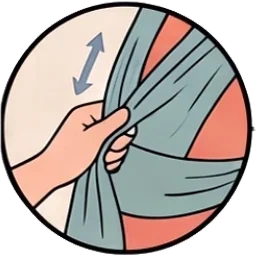
Tight and snug

In view and close enough to kiss
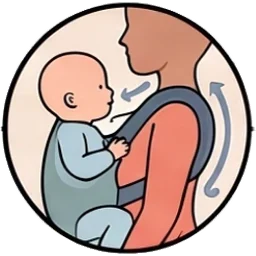
Chin off the chest, back curved
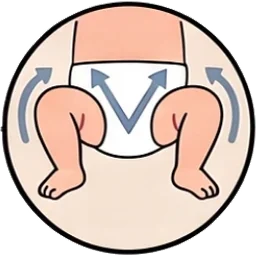
Hips in an “M”
The carrier should be snug, hugging your baby against you. If you rest your hand on their back and press gently, they should not slump or shift towards you. Loose fabric lets them slide down and curl up, and that can make breathing harder.
You should be able to see their face just by looking down, without moving any fabric. Nothing should cover their nose or mouth.
Their head should be so high that you can kiss their forehead by tipping your head forward a little.
Check that at least a finger fits between their chin and their chest. If the chin rests on the chest, the airway can partly close.
Their back stays in its natural curve, with tummy and chest against you, without slumping or twisting.
To these five I always add a sixth, as Pathways.org’s guide suggests: healthy hips, with the knees higher than the bottom and the legs in an “M”.
If they fall asleep, check the T, the I and the K again. That is when the head can drop forward. Babies under 4 months are the most vulnerable: they cannot yet control their head well and cannot correct their position by themselves.
In babywearing, the milestone matters, not the age. Every baby has their own pace, and months of difference between one and another are normal. If you want a guide to what is usual at each stage, there is the milestones by age guide.
To start from birth, your baby only needs to reach the minimum weight the carrier’s maker states. If they were born premature or with a low birth weight, ask first.
And until when? There is no age limit. It depends on what you and your child need. If you carry them from small, your back will get used to the extra weight little by little.
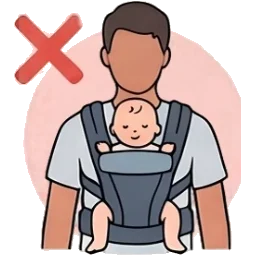
Facing out: no
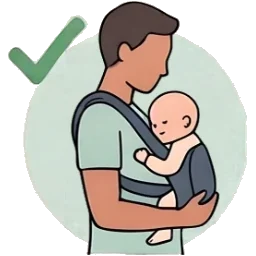
Always tummy to tummy
And three tips that help a lot day to day: bend at the knees, never at the waist; alternate the side they rest their head on each time you carry them, to prevent positional muscular torticollis; and take breaks when they, or your back, ask for one.
In some situations it is better to have an individual assessment before you start babywearing or change position:
Often you can keep babywearing, adapting the carrier and the position to what your baby needs.
Babywearing well is learned. It is hard the first few times, and it is normal to have doubts. You do not have to do it perfectly: just go through the TICKS rule each time and watch your baby. If they are calm, breathing well and you can see their face, you are on the right track.
If you have doubts about how you carry them or about their development, you can ask for an assessment. We look at it calmly.
Sources
This information is for guidance only and does not replace an individual assessment by a professional.