
Does your baby's head look flatter to you?

Positional plagiocephaly

One day, while you are bathing them, brushing their hair or gazing down at them as they rest in your arms, the question that worries so many parents comes up: does your baby's head look flatter to you?

In the vast majority of cases, what we are looking at is what we call positional plagiocephaly.

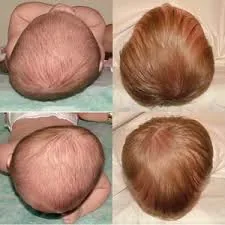
Positional plagiocephaly is an asymmetric deformity or flattening at the back or side of an infant's head, caused by the continued action of external mechanical forces on a skull that is still developing. During the first months of life, a newborn's skull bones are soft and joined by open sutures, to allow the brain to grow rapidly and to ease the passage through the birth canal. For this reason, if the head rests on the same spot for long periods, that area tends to give way and flatten.

Four baby heads seen from above: the two on the left are flattened at the back on one side; the two on the right are rounder.
Illustrative image.

What are the causes of positional plagiocephaly?

The direct cause of the flattening is repeated resting on the same spot, but the key question from a physiotherapy point of view is: why does the baby always rest towards the same side? Among the main factors are:

  • Congenital muscular torticollis or postural preference
  • Sleeping position
  • Little time on their front (tummy time) and excessive use of restraint devices (car seats, pushchairs, bouncers, etc.)
  • Intrauterine or birth factors A multiple pregnancy (twins), lack of space in the womb, large babies, prematurity or assisted deliveries (forceps or ventouse) can cause initial moulding or a preference for resting on one side from birth.

The importance of physiotherapy and early treatment

When plagiocephaly is present, specialised paediatric physiotherapy is the first line of intervention.

Why is acting early decisive?

During the first months of life (especially between 0 and 5-6 months), a baby's skull grows at its fastest rate and has a high degree of plasticity. What flattens quickly at this stage can also round out soon if we take the pressure off in time. Also, before 5 months the baby cannot yet move around independently, which makes positioning measures and manual therapy maximally effective.
How does physiotherapy help?

In clinic we do not only address the shape of the head, but the cause behind it. We treat torticollis or neck tension with gentle manual therapy techniques, stretches and mobilisations to give the neck back its full range of movement. We also teach parents motor stimulation exercises and guidelines for encouraging time on their front in a safe and friendly way. The evidence shows that a physiotherapy programme significantly reduces the risk of severe deformity compared with giving generic positioning advice alone.

Book an assessment

In clinic we quantify plagiocephaly: measurement with a craniometer

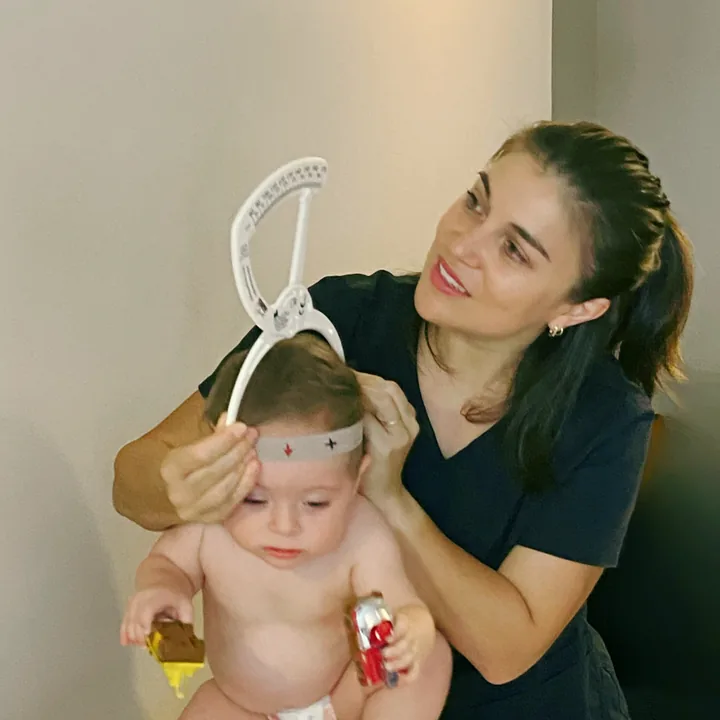
To follow your baby's progress with the utmost professional rigour, we do not rely on a simple visual impression. In clinic I quantify plagiocephaly using a craniometer (an anthropometric calliper designed for an infant's head).

With this instrument, we measure the cranial diameters and diagonals to calculate objective asymmetry indices (such as the cranial vault asymmetry index, or CVAI). This assessment allows us to:

Constanza holds a seated baby and places the craniometer, a white arc with a scale, on the baby's head.
Measurement with a craniometer in clinic.
  1. Confirm the presence of plagiocephaly

    And tell it apart from other conditions.

  2. Classify the degree of deformity objectively

    Determining whether it is mild, moderate or severe.

  3. Measure real progress in millimetres and percentages

    Session after session, verifying the effectiveness of the treatment and adjusting our strategies to your baby's exact progress.


Physiotherapy vs. helmets (cranial orthoses): which is better in each case?

Many parents come to the clinic wondering whether their child will need an orthopaedic helmet. The scientific evidence gives us clear guidelines depending on the quantified degree of deformity:

Mild plagiocephaly

The treatment of choice is 100% conservative: paediatric physiotherapy combined with positioning measures at home. The scientific literature shows that mild deformities respond optimally when neck mobility is freed up and the resting points are redirected. In these cases, a helmet is not indicated and brings no additional benefit.

Moderate or severe plagiocephaly

Initial phase (0 to 5-6 months)

Physiotherapy remains the first line of action. By intervening early with manual therapy and motor re-education, the asymmetry decreases markedly and most babies manage to correct without needing an orthosis.

When an orthopaedic helmet is indicated

A helmet is considered as a second line of treatment, mainly in moderate or severe deformities that have not shown the expected improvement after well-executed conservative treatment up to 5 or 6 months of age, or in cases diagnosed very late.

What does the evidence say when comparing them?

The helmet acts as an external mould that speeds up the rate of correction in the first months of use in moderate and severe asymmetries. However, systematic reviews and clinical trials indicate that, in the long term (at 12 and 24 months), head-shape outcomes with appropriate conservative treatment and with a helmet tend to even out. In addition, a helmet does not correct torticollis or the underlying neck restriction, so physiotherapy remains essential to treat the primary cause.


A reassuring message for the family

Finding an asymmetry in your baby's head can be worrying, but remember that spotting it in time is the first step towards solving it. With the right assessment, measurement in clinic and paediatric physiotherapy support adapted to your child's needs, we can give their neck back its mobility and guide the natural rounding of their little head as they grow.

Sources

  • Sargent, B., Coulter, C., Cannoy, J., & Kaplan, S. L. (2024). Physical therapy management of congenital muscular torticollis: A 2024 evidence-based clinical practice guideline from the American Physical Therapy Association Academy of Pediatric Physical Therapy. Pediatric Physical Therapy, 36(4), 370–421. https://doi.org/10.1097/PEP.0000000000001114
  • Castaño-Bustos, D., Agudelo-Arrieta, M., Ocampo-Navia, M. I., Chacón-Valencia, S. E., Pérez-Méndez, W., & Vergara-Lago, M. (2026). Is helmet therapy effective in positional plagiocephaly? A systematic review and proposal for an updated management algorithm. Child’s Nervous System, 42, 236. https://doi.org/10.1007/s00381-026-07306-9
  • van Wijk, R. M., van Vlimmeren, L. A., Groothuis-Oudshoorn, C. G., van der Ploeg, C. P., IJzerman, M. J., & Boere-Boonekamp, M. M. (2014). Helmet therapy in infants with positional skull deformation: randomised controlled trial. BMJ, 348, g2741. https://doi.org/10.1136/bmj.g2741
  • Baird, L. C., Klimo, P., Flannery, A. M., Bauer, D. F., Beier, A., Durham, S., ... & Tamber, M. S. (2016). Congress of Neurological Surgeons systematic review and evidence-based guideline for the management of patients with positional plagiocephaly: the role of physical therapy. Neurosurgery, 79(5), E630–E631. https://doi.org/10.1227/NEU.0000000000001429
Book a visit